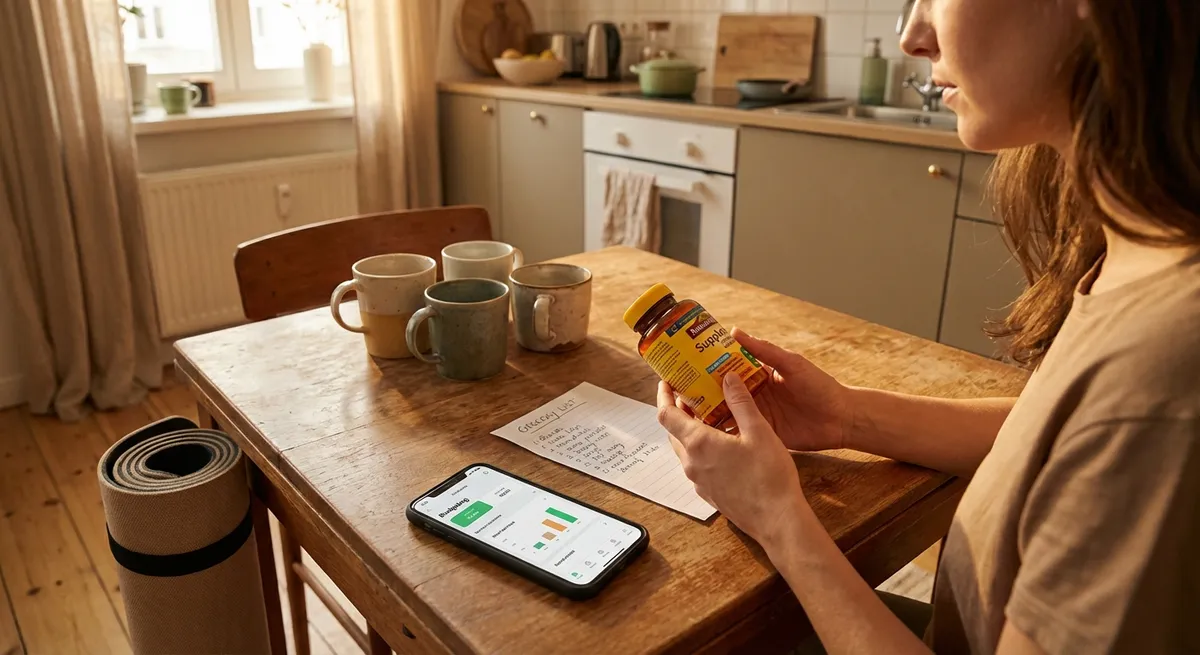
Health spending can quietly turn into one of the biggest line items in your budget—especially when every week brings a new “must-have” supplement, gadget, or program. Between influencer recommendations and polished marketing, it’s easy to overspend on things that don’t move the needle for your well-being.
This guide helps you navigate health-related purchases with a clear head. You’ll learn how to sort real value from clever branding, how to think about long-term costs, and how to avoid paying extra for results you could get more cheaply—or for free.
Start With Your Actual Health Needs, Not the Product
Most health purchases go wrong before you ever click “Buy”—because the product drives the decision, not your needs.
Before you consider anything new (a smart watch, a supplement, a meal plan, a fitness app), step back and define the problem you’re trying to solve. Is it poor sleep, low energy, joint pain, weight management, blood pressure, stress, or something else? If you can’t clearly state the health outcome you want, you can’t really judge whether a purchase is worth it.
Talk to your healthcare provider about your goals when possible. They can help you figure out whether you truly need a product, or whether lifestyle changes (better sleep habits, more walking, dietary tweaks) should come first. This doesn’t just protect your wallet—it can protect your health from unregulated or unnecessary products.
A “need-first” approach also makes comparison easier. Instead of “Should I buy this $200 at-home massage device?” the question becomes “What’s the best, safest, and most cost-effective way to manage my back pain?” That opens up a broader set of options: physical therapy referrals, targeted exercises, posture changes, and possibly cheaper tools that actually address the issue.
How to Judge Health Claims Without a Medical Degree
Health products often lean on impressive-sounding language: “clinically proven,” “backed by science,” “doctor-formulated.” Those phrases can be vague or misleading if you don’t know what’s behind them.
Look for specifics. Real evidence usually refers to actual research: randomized controlled trials, named institutions, or published journal articles. Vague references like “studies show” or “experts agree” without links or details are a red flag. Check if the brand cites independent research (studies done by universities or hospitals), not just internal data.
Be wary of products that promise to “detox,” “boost your immune system,” or “cure” a wide variety of unrelated issues. The more sweeping and instant the claim, the less likely it’s grounded in solid science. Many credible organizations—like major hospitals and government health agencies—provide consumer-friendly breakdowns of what’s really proven to work for common conditions.
Finally, look for disclaimers. Supplements in many countries are not regulated as strictly as medications. Labels that admit “This product is not intended to diagnose, treat, cure, or prevent any disease” are required by law in some regions. That doesn’t mean a product is useless, but it does mean you should approach bold health claims with extra scrutiny.
Practical Tip #1: Build Around Free (or Low-Cost) Foundations First
Before you spend a dollar on health tech, powders, or programs, make sure you’ve exhausted the basics that cost little or nothing. Many of the biggest health gains come from changes that require intention more than equipment.
Sleep, movement, nutrition, and stress management are core drivers of health outcomes. Walking regularly, following simple home workouts, drinking enough water, setting a reasonable bedtime, and cooking at home more often can all have meaningful impact—and they’re usually cheaper than subscriptions or devices.
If a product is supposed to “optimize” something you haven’t even made consistent yet (for example, a sleep tracker when you’re still scrolling in bed for two hours a night), it’s often premature. Use that as a rule of thumb: make at least a 30-day effort at a behavior-level change before you pay to “enhance” it.
This approach also helps you avoid buying “motivation” in the form of things—expensive gym clothes, equipment, or kitchen tools—when what you really need is a simpler plan and realistic habits. Once you’ve proven to yourself that you’re committed, targeted purchases can genuinely amplify your efforts.
Practical Tip #2: Compare Long-Term Cost, Not Just the Price Tag
A product that looks cheap upfront can become expensive over time, while something with a higher initial price might save money in the long run. When evaluating health purchases, always think in terms of cost per month—or even cost per use.
Subscriptions (fitness apps, meditation platforms, meal kits, supplement boxes, health coaching) can quietly stack up. Before you sign up, calculate a one-year cost and ask yourself whether you’ll still use it in six months. If there’s a free trial or a monthly plan option, use it to test whether it actually fits your life before committing to a longer-term contract.
For physical products, think about durability and ongoing costs. A cheaper blender you replace every year may cost more over five years than a sturdy one that lasts. A home exercise item you’ll use three times a week for years might actually be lower cost per use than a cheaper gadget that ends up in a closet.
Apply the same lens to healthcare routines. A lower-cost provider or service that doesn’t address the root problem could lead to more expenses down the line, whereas evidence-based care upfront—like physical therapy for chronic pain instead of ongoing quick fixes—may be a smarter long-term investment.
Practical Tip #3: Prioritize Safety and Regulation Over Trendiness
With health purchases, saving money should never come at the expense of safety. Some categories require extra caution: supplements, at-home medical devices, wearable sensors, and anything that claims to diagnose or treat a condition.
Check whether a product needs regulatory clearance or approval where you live. For example, in the U.S., certain medical devices are reviewed by the FDA; in the EU, devices may need CE marking. If a gadget claims to measure or manipulate your health in a medical way (blood pressure, heart rhythm, glucose, oxygen levels), you want it to be regulated or recommended by a credible medical source.
For supplements, choose brands that provide third-party testing for purity and quality (for example, NSF, USP, or other recognized certifiers, depending on your region). Look for transparent ingredient lists and avoid proprietary blends that hide actual amounts.
Most importantly, if you have existing medical conditions or take medications, talk to your doctor or pharmacist before adding new supplements or devices. This may feel like an extra step, but it can prevent dangerous interactions and wasted money on products that don’t fit your situation.
Practical Tip #4: Use Return Policies and Trial Periods Strategically
Health purchases can be highly personal. What motivates one person to exercise or sleep better might not work for you at all. That makes return policies and trial periods valuable tools for smart buying, not just afterthoughts.
Before purchasing, read the fine print on returns and trials. Can you get a full refund if the fitness tracker doesn’t fit well or the mattress worsens your back pain? Is there a restocking fee? Does the subscription auto-renew if you forget to cancel before the trial ends?
Plan a structured trial for yourself. For example, if you buy a new pair of running shoes, commit to using them on specific days during the return window, paying attention to comfort, support, and any pain. For a sleep gadget or meditation app, track whether your sleep duration, energy level, or stress feels noticeably better.
If a product or service doesn’t clearly improve your experience or help you move toward your health goals within the trial period, use the return option instead of letting the cost sink in out of guilt. Treat trials as experiments: you’re not failing if something doesn’t work—you’re learning what does.
Practical Tip #5: Match Features to Your Behavior, Not Your Aspirations
Health tools and tech often come packed with features you may never use. It’s easy to justify a premium purchase by imagining your “ideal self” using every measurement and mode. To avoid overspending, buy for your real behavior today, not the fantasy version of yourself six months from now.
For example, when considering a fitness tracker, list the functions you actually care about: step counting, heart rate, sleep tracking, GPS for runs, or integration with a specific app. If you’re unlikely to use advanced training metrics, on-wrist calls, or music storage, you may not need the high-end model.
The same logic applies to kitchen gadgets, workout equipment, or wellness apps. If you mostly cook simple meals, a basic, reliable set of tools can be more valuable than a specialized device that takes up space. If you know you won’t log into a complicated dashboard, a simpler app may help you stay consistent.
When in doubt, start small. Try a more basic version or even a free alternative first. If you outgrow it and find yourself limited by missing features that would genuinely improve your routine, upgrading will be a more informed—and usually more satisfying—purchase.
Conclusion
A healthier life doesn’t have to mean a more expensive one. The key is flipping your mindset from “What health product should I buy?” to “What health outcomes do I care about, and what’s the smartest way to support them?”
By focusing on your real needs, checking claims against credible evidence, building around low-cost foundations, and treating trials as experiments, you can avoid hype-driven spending and direct your money toward tools that truly help. Over time, that approach doesn’t just protect your budget—it builds a health routine that actually fits your body, your schedule, and your priorities.
Sources
- National Institutes of Health – Dietary Supplements: What You Need to Know - Explains how supplements are regulated, how to evaluate safety and claims, and when to talk to a healthcare provider
- U.S. Food & Drug Administration – Consumers: Medical Devices - Provides guidance on how medical devices are regulated and what consumers should consider before use
- Centers for Disease Control and Prevention – Physical Activity Basics - Outlines evidence-based recommendations for physical activity and its health benefits
- Mayo Clinic – Sleep Tips: 7 Steps to Better Sleep - Offers practical, research-informed strategies to improve sleep without expensive products
- Harvard T.H. Chan School of Public Health – Healthy Eating Plate & Pyramid - Provides science-based guidance on building a healthy diet, useful before considering paid diet plans or supplements
Key Takeaway
The most important thing to remember from this article is that this information can change how you think about Health.