For many businesses, the difference between a smooth operation and constant firefighting comes down to one thing: the quality of the equipment you buy. Forklifts, CNC machines, office printers, packaging lines, generators—these purchases tie up capital, shape your workflows, and affect your reputation with customers. Yet many companies still buy on price alone, react to emergencies, or depend on whichever vendor calls first. This guide walks you through how to approach business and industrial purchases strategically, with five practical tips you can use on your next RFQ, lease, or bulk order.
Know the Job, Not Just the Specs
Before you look at brands or prices, define the job the equipment needs to do in everyday reality—not just on a spec sheet.
Start with your current workflow: where are the bottlenecks, breakdowns, or safety issues? A warehouse might think it “needs more forklifts” when the real issue is poor slotting or congested aisles. A shop might think it needs a faster machine when what it actually needs is better uptime and easier changeovers.
Write down:
- What tasks this equipment must handle daily, weekly, and seasonally
- Your throughput targets (units per hour, shifts per day, etc.)
- Environmental conditions (dust, heat, cold, moisture, chemicals)
- Who will use it (skill level, training available, number of operators)
- Safety and compliance requirements for your industry
Then translate these into performance requirements, not just buzzwords. Instead of “high-capacity forklift,” define “must safely handle 3,000 lb pallets in 10-foot aisles with racking up to 24 feet.” Instead of “industrial printer,” define “must reliably print 5,000 labels per shift with scannable barcodes and minimal downtime.”
Vendors will always highlight strengths; a clear job description keeps the conversation anchored in your needs, not their marketing.
Total Cost of Ownership Beats Sticker Price
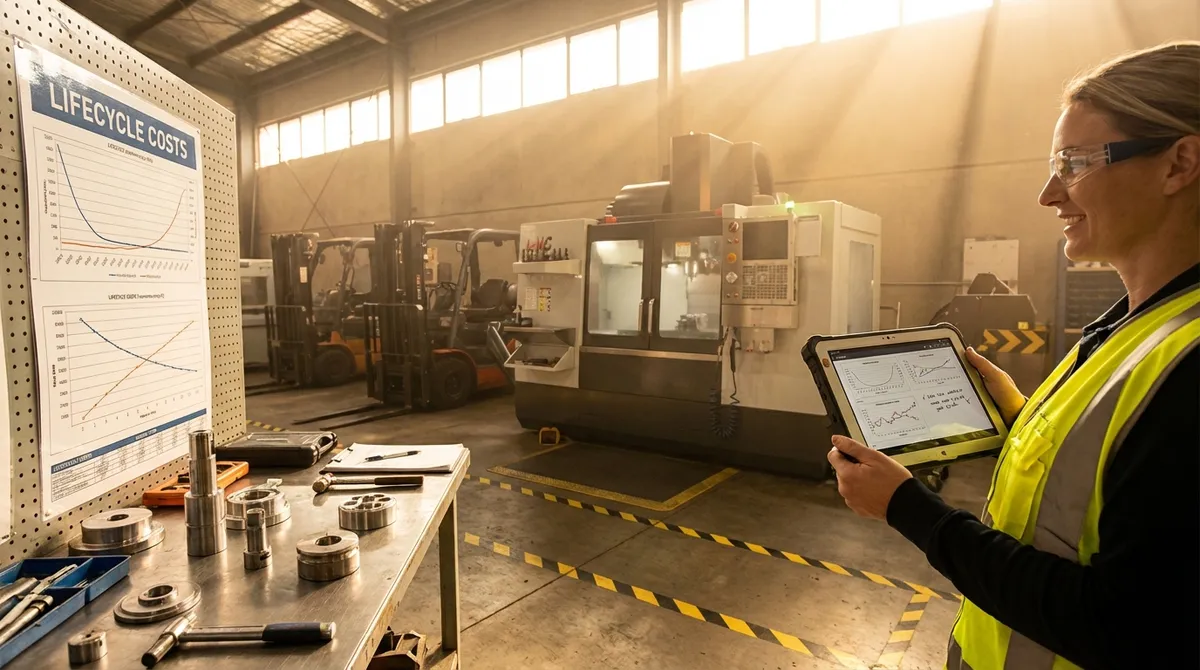
A cheaper upfront quote can become the most expensive choice over the life of the equipment. Focus on total cost of ownership (TCO)—everything you’ll spend from day one to retirement.
Consider these TCO components:
- Purchase or lease price: Initial cost plus taxes, delivery, and installation
- Energy consumption: Power, fuel, or compressed air usage over typical operating hours
- Maintenance and repairs: Scheduled service, typical failure points, and part prices
- Downtime costs: Lost production, expedited shipping, overtime, and customer impact
- Consumables: Blades, filters, ink, lubricants, packaging materials
- Training and change management: Time and resources to get staff up to speed
- Resale or disposal value: How the equipment holds value and what it costs to decommission
When comparing quotes, ask each vendor to provide estimated annual operating and maintenance costs under your specific use case. Even approximate numbers will reveal big differences in long-term spend.
For energy-intensive or always-on equipment (compressors, HVAC, refrigeration, IT gear, motors), efficiency ratings can make a major impact over years of use. Higher-efficiency options may pay back the price premium through lower utility bills and reduced downtime.
Vendor Reliability Is Part of the Product
In business and industrial purchases, you’re not just buying equipment; you’re buying a relationship with a vendor or distributor. How they handle service calls, parts availability, and technical questions will matter far more than a glossy brochure once the equipment is on your floor.
Evaluate vendors on:
- Response times: How quickly they answer support calls and emails
- Service coverage: On-site capabilities in your region, and whether they use third-party techs
- Parts availability: Typical lead times for critical components and common wear parts
- Training and documentation: Clarity of manuals, access to training, and online resources
- References and case studies: Similar businesses they’ve successfully supported
Ask specific, situational questions:
- “What is your average response time for critical service calls in our area?”
- “Which parts are typically stocked locally and which are special order?”
- “Can you share three references from companies of similar size in our industry?”
- “What does your warranty actually cover—and exclude?”
A vendor who is transparent, detail-oriented, and willing to answer tough questions upfront is more likely to be a steady partner when problems arise. If answers are vague or rushed now, support probably won’t improve later.
Build Flexibility Into Today’s Purchase
Business needs change quickly—new product lines, new regulations, new customers, or growth into new markets. When evaluating equipment, consider how it will adapt, not just how it works on day one.
Look for:
- Modular designs: Machines that can accept add-ons (extra heads, conveyors, sensors, software modules)
- Scalability: Ability to run more shifts, add parallel units, or increase throughput without replacing everything
- Open standards and compatibility: Equipment that works with common software, file formats, connectors, and control systems
- Software upgradability: Clear path for firmware updates or optional features without replacing hardware
- Adjustability: Easy changeovers for different product sizes, materials, or packaging formats
Ask vendors what typical upgrade paths look like and how often customers outgrow the model you’re considering. The goal is not to overbuy “just in case,” but to avoid locking into equipment that can’t stretch with your business for at least a realistic time horizon (often 5–10 years for major assets).
This kind of flexibility becomes especially important in fast-changing sectors like e-commerce fulfillment, food processing, or advanced manufacturing, where product mixes and regulatory demands are constantly shifting.
Negotiate Terms That Protect Your Operations
Once you’ve chosen equipment and a vendor, the contract is where you protect your business. Many buyers focus only on price and delivery date, but smart terms can prevent costly headaches.
Focus your negotiation on:
- Performance criteria: Clear uptime, throughput, or accuracy expectations tied to your real-world use—not just lab specs
- Acceptance testing: A defined process for verifying the equipment meets agreed standards before final payment
- Warranty details: Duration, what’s covered (parts, labor, travel), and what voids the warranty
- Service-level agreements (SLAs): Response times for different severity levels of issues
- Spare parts strategy: Initial parts kit, pricing, and guaranteed availability windows
- Training and documentation: Included onsite training sessions, manuals, and ongoing support access
- Exit options: Terms for upgrades, trade-ins, or early termination for underperformance
You don’t need to win every point to protect yourself. Often, clarifying expectations in writing—especially around support and performance—prevents disputes, speeds up problem resolution, and makes the partnership smoother for both sides.
If the purchase is large relative to your business size, consider having a legal or procurement professional review key clauses, especially around liability, data (for connected equipment), and long-term obligations.
Conclusion
Business and industrial purchases are too important to leave to gut feeling, habit, or the lowest quote. By defining the real job, looking beyond sticker price, treating vendors as long-term partners, planning for flexibility, and negotiating smart terms, you turn each purchase into a strategic asset instead of just another line item.
The next time you request a quote or sit through a sales demo, bring these five tips with you. Use them as a checklist, ask better questions, and slow down just enough to think in years instead of months. The payoff shows up in fewer breakdowns, steadier production, and more room in your budget for the investments that really move your business forward.
Sources
- U.S. Small Business Administration – Buy an Existing Business or Franchise – Offers guidance on evaluating business assets and vendor relationships, useful context for large capital purchases
- U.S. Department of Energy – Energy-Efficient Products – Explains how to factor energy efficiency into purchasing decisions and calculate long-term savings
- Occupational Safety and Health Administration (OSHA) – Safety and Health Programs – Highlights the importance of safety and compliance when selecting industrial equipment
- MIT Sloan Management Review – Total Cost of Ownership – Discusses the concept of total cost of ownership and why it matters for strategic purchasing
- Harvard Business Review – How to Negotiate with Powerful Suppliers – Provides practical negotiation strategies that can be applied when securing terms with equipment vendors
Key Takeaway
The most important thing to remember from this article is that this information can change how you think about Business & Industrial.